
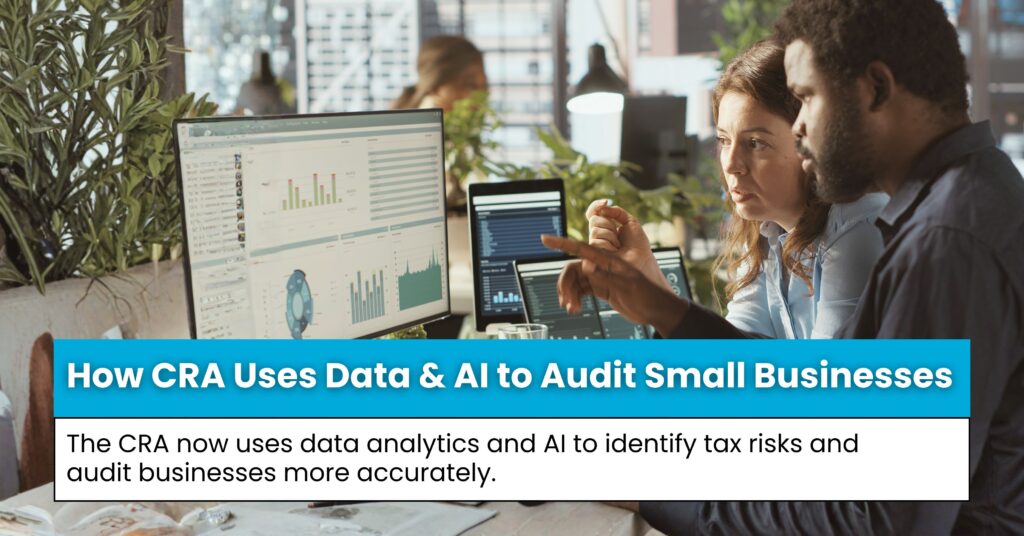
For years, many small businesses believed CRA audits were random. Today, that assumption is no longer true. The Canada Revenue Agency (CRA) has quietly transformed how it selects and conducts audits—by using data analytics, artificial intelligence (AI), and predictive risk modelling to identify non‑compliance faster and more accurately than ever before.
This shift has drastically reduced random audits and increased targeted reviews, especially for small and medium‑sized businesses where errors are more common but often unintentional.
Here’s how the CRA uses data and AI—and what it means for small business owners in Canada.
CRA Collects More Third‑Party Data Than Most Businesses Realize
The CRA no longer relies mainly on what you report. It cross‑checks your filings against third‑party data received directly from:
- Banks and credit card processors
- Employers and payroll submissions (T4s, T4As, T5s)
- Digital platforms (Shopify, Amazon, Uber, Airbnb, Etsy)
- Property registries and land transfer systems
- Foreign tax authorities (CRS, FATCA)
This data is automatically matched against your income tax, GST/HST, and payroll filings.
If your reported revenue doesn’t align with bank deposits or platform reports, CRA systems flag the inconsistency immediately—often before a human ever reviews the file.
Risk Scores Replace “Random” Audits
CRA now assigns risk profiles to businesses using predictive analytics. These systems analyze patterns such as:
- Repeated business losses
- Higher‑than‑average deductions
- GST/HST refunds are inconsistent with sales
- Payroll remittances lag behind revenue
- Large year‑over‑year income swings
Businesses that fall outside industry norms are far more likely to be selected for audit.
Important: A return can be technically “correct” and still get flagged if the pattern looks abnormal.
AI Flags Mismatches Between GST/HST, Payroll, and Income
One of the CRA’s strongest audit tools is cross‑program matching. AI systems compare:
- GST/HST sales vs reported revenue
- Payroll expenses vs declared income
- Contractor payments vs T4A filings
- Input Tax Credits vs actual business activity
Even minor inconsistencies can trigger a combined audit, where CRA reviews multiple tax programs at once.
This is why many businesses that file everything “on time” are still selected for review.
Digital Record Reviews Are Now the Default
CRA increasingly requests electronic records, including:
- Accounting software files (QuickBooks, Xero, Sage)
- Bank statements and POS reports
- Excel spreadsheets and backups
- Digital receipts and invoices
AI tools analyze these records to detect anomalies, duplicate expenses, unsupported deductions, and unexplained deposits.
Key takeaway:
If your books can’t be explained digitally, they’re harder to defend.
AI Learns From Past Audits
CRA’s machine‑learning models improve over time. When auditors identify new compliance issues, those patterns are fed back into the system, making future detection more precise.
This is particularly relevant for:
- E‑commerce businesses
- Cash‑intensive industries
- Contractor‑heavy operations
- Gig and platform‑based income
What worked five years ago to “stay under the radar” no longer works today.
Small Businesses Are a Primary Focus
Government audit data shows that small and medium enterprises (SMEs) are a key compliance target—not because of fraud, but because of high rates of unintentional non‑compliance.
Common triggers include:
- Personal expenses mixed with business costs
- Late GST/HST registration
- Misclassified workers
- Unsupported home office or vehicle deductions
How Small Businesses Can Reduce Audit Risk
You can’t opt out of AI‑driven enforcement—but you can adapt:
Reconcile regularly
Monthly or quarterly reconciliation catches issues before CRA systems do.
Align all tax programs
GST/HST, payroll, and income filings must tell the same story.
Keep audit‑ready digital records
Assume CRA will request electronic data—not paper receipts.
Focus on consistency, not just deductions
Outliers trigger audits more often than lower tax bills.
Final Thought
CRA audits today are data‑driven, predictive, and increasingly automated. Small businesses that treat tax compliance as a year‑round process—not a once‑a‑year filing—are far less likely to receive CRA review letters.