

Running a successful small business often leads to one big question:
“Should I set up a holding company?”
For many Canadian entrepreneurs, this is a natural next step once the business becomes profitable. But a holding company isn’t just a sign of growth — it’s a strategic tax and asset-protection tool when used correctly.
This article explains what a holding company is, why and when to consider one, and the key tax benefits and cautions you should know before you incorporate.
🔍 What Is a Holding Company?
A holding company (Holdco) is a separate corporation that owns shares or assets of another company — typically your operating company (Opco).
• Opco runs the business — it earns income, pays expenses, and carries risk.
• Holdco simply holds investments, retained earnings, or property.
You can move money from Opco to Holdco as tax-free inter-corporate dividends (thanks to subsection 112(1) of the Income Tax Act), as long as both are Canadian-controlled private corporations (CCPCs).
💡 Why Business Owners Use Holding Companies
- Asset Protection
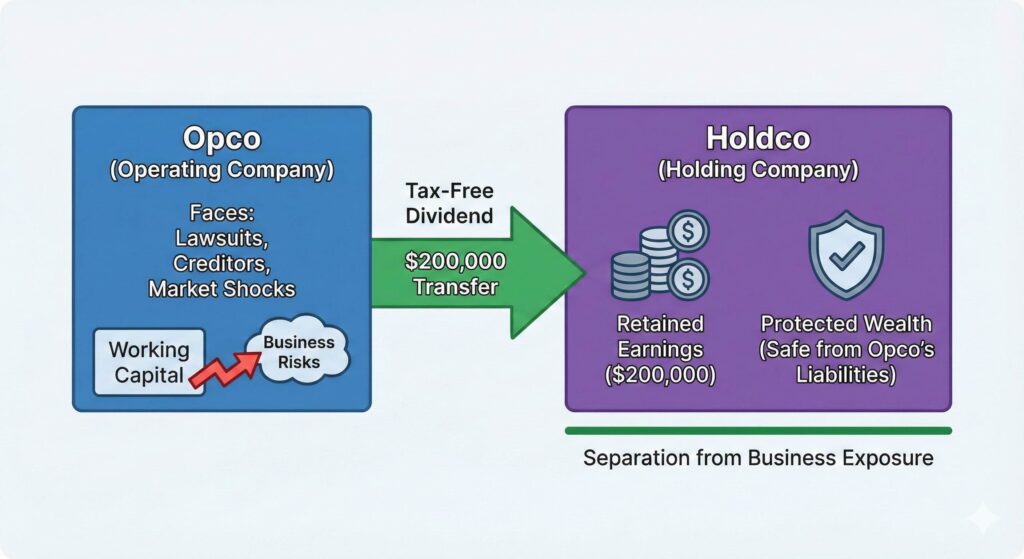
Your operating company faces business risks — lawsuits, creditors, market shocks.
By moving surplus cash or investments to a Holdco, you protect wealth from Opco’s liabilities.
Example: Opco transfers $200,000 in retained earnings to Holdco via a tax-free dividend, keeping working capital safe from business exposure. - Tax Deferral and Income Splitting
When profits exceed what you need personally, keeping them inside a corporation allows tax deferral.
The small business tax rate (about 12–13% in Ontario) is much lower than personal marginal rates (up to 53%).
You can reinvest after-tax corporate profits through Holdco and delay personal tax until funds are withdrawn.
Holdcos can also facilitate income splitting using family trusts or multiple shareholders — subject to the Tax on Split Income (TOSI) rules. - Investment and Real Estate Growth
A Holdco is ideal for building a corporate investment portfolio — real estate, market securities, or lending to other ventures.
This keeps investment income separate from business operations, simplifying bookkeeping and preserving Opco’s small business deduction eligibility. - Business Succession and Estate Planning
Holding companies streamline ownership transfers and freeze strategies.
By having Opco shares held by Holdco, it’s easier to:
• Introduce children or new partners,
• Apply a section 85 rollover for tax-deferred transfers, or
• Use the Lifetime Capital Gains Exemption (LCGE) efficiently when selling shares.
🕐 When It Makes Sense to Set Up a Holdco
A holding company is beneficial when you meet one or more of these conditions:
✅ Situation 💬 Why a Holdco Helps
You have excess retained earnings in Opco Allows safe, tax-free transfer of funds
You plan to invest or buy real estate Keeps investment income separate
You want asset protection Shields wealth from operational risks
You’re planning succession or sale Simplifies tax planning and LCGE access
You own multiple corporations Centralizes control and inter-company loans
If your Opco earns consistent profits (say $150,000+ annually after expenses) and you’re not withdrawing all of it personally, it’s time to talk to your accountant about incorporating a Holdco.
⚠️ When It Might Not Be Worth It
A holding company adds complexity and cost:
• Separate T2 corporate tax returns
• Annual bookkeeping and legal filings
• Possible Part IV tax if investment income grows too large
• No benefit if you withdraw all profits personally each year
So, if your business is small, new, or using up all earnings for operations, you might wait until cash accumulation justifies the structure.
📊 Real-World Example
Scenario:
Maria owns a marketing firm (Opco) earning $250,000 annually. She needs $100,000 for personal living expenses.
Without a Holdco:
• She pays herself all $250,000 → higher personal tax bracket.
With a Holdco:
• Opco pays $100,000 salary/dividend to Maria.
• The remaining $150,000 moves tax-free to Holdco, taxed later only when withdrawn personally.
• Maria reinvests through Holdco — deferring ~40% personal tax and protecting her savings.
🧭 The Bottom Line
A holding company is a powerful tool — but only when your business has steady profits and long-term goals.
It can:
• Protect assets
• Reduce risk
• Enable tax deferral and estate planning
But it’s not a one-size-fits-all solution. Always consult a CPA or tax advisor before setting one up to ensure the structure fits your specific corporate and family circumstances.

✅ Need Tax Help! Contact Us Today!
📞 Call us today: 416-828-7462
🌐 Visit: www.blueocean.tax